The Growth 001
A field journal from a decommissioned convent and school in Greenpoint, Brooklyn.
A letter from the gardeners.
Dear reader, welcome to The Growth. The Growth is a local-AI magazine published by The Grove, and our way of catching, between covers, everything that has grown out of the building: the meetups, the demos, the half-built projects upstairs, the people who come through, the conversations the boilers don't drown out. The Grove is a non-profit network R&D lab; our work is accelerating local AI: its usage, its accessibility, and its capability. We work out of a decommissioned convent and school in Greenpoint, across the street from McCarren Park: the garden on the roof, the hardware in the basement. Researchers, builders, artists, and scientists share the building; The Grove is what happens when we share the infrastructure too.
“An inexplicable anomaly in space-time” is how James Barnes, who founded ETHEREA (the live generative-stage project profiled in § IV) and lives upstairs, described the building to us recently. We are inclined to agree. A 110-year-old Catholic property in the most expensive housing market on the continent; a meetup that pulled in, on a given Tuesday last month, the founder of a twenty-year-old art-technology company who walked back in the next morning and took a desk down the hall. These are not things that ordinarily happen, and we do not take them lightly.
None of it is for sale. We hope you keep the journal. If you want to come by, the next meetup is Thursday, May 28. Full details, and an RSVP, are pinned at the end of § III.
This issue was reported with Prompter, an open-source documentarian agent donated to The Grove by James Barnes. It grew out of Say's interviewing work: agents that ask people better questions, preserve human stories, and turn lived experience into films, essays, and records without replacing the person at the center of them. The near-term plan is to make Prompter run fully locally on Greenpoint Compute Co-op resources.
Yours from The School, Dmarz and James Barnes, the editors.
In defense of software that stays home.
Local-first is not a feature. It is a way of being neighborly with your own tools.
A piece of software that lives on your computer is a piece of software you can break, fix, and outlive. It does not ask permission to start. It does not phone home to confirm you are still allowed to open the file you wrote yesterday afternoon. The garden is here, on this desk; the cloud is a place we visit on purpose.
Every tool profiled in this issue is dogfooded on our campus, The School. The author and the user are usually across a hallway.
The argument for local AI extends this register by one syllable. A model that runs on your laptop is yours in the way your file is yours: the audio you feed it never leaves the room, the response arrives in forty milliseconds rather than fifteen hundred, and no policy update on a faraway server can quietly make it forget how to do the thing you depended on it for last week. Cost falls out of the same fact. You have already bought the silicon, and it does not bill you per token.
There is a quieter argument too. A model that has lived on your machine for a year has heard your half of every conversation you handed it; it has learned which words you use that other people don't. That is either an intimacy or a leak depending on where the model lives. We prefer the version where the intimacy stays yours.
Dmarz, who steers The Grove's local-LLM work and writes most of the software profiled here, frames the broader stakes more bluntly. The markets that built the cloud have, by ordinary economic gravity, “warped the fields of the arts and sciences.” Local-first is, in his telling, one of the ways a community of practitioners defends itself from the icebergs of incentives: a small, quiet refusal of the funnel that points every model toward the same five companies. Historically, he points out, the best work of any given era tends to depend on patronage: the conversion of excess wealth into the slow, illegible projects that markets price wrong. The Grove is a bet that the same is still true.
The financial register has been through this once already. The cypherpunks of the nineties wanted self-sovereignty over money: the capacity to send a payment or hold a balance without asking a custodian to permit it. Bitcoin, then Ethereum, made the position partially tractable, and a generation of people now hold keys they could not have held in 2008. Cloud AI is in roughly the position banks were in. A small number of intermediaries hold the weights, set the policy, and decide which questions the system will answer; the unit economics are similarly load-bearing. Their pricing, for now, is ours: by some estimates, the compute behind a flat-rate power user costs many times more than the subscription brings in. The subsidy is a hiring tactic, not a steady state; the pricing will move when the market closes.
When it does, the local-AI position will look like the self-custody position did in 2017: a slower, sometimes inconvenient register that nevertheless preserves the basic property of being able to use the tool tomorrow. Vitalik Buterin, writing on secure LLMs, asks the question we keep arriving at: “What kind of AI setup would we build if we took privacy, security and self-sovereignty as non-negotiable?” AI will change which fields stay legible to human practitioners, and probably which institutions exist in twenty years. The question of who controls the weights is not a small one.
There is also the question of which net you reach for. When you are building connectivity between pieces of software, why go all the way out to a remote server when the person you want to talk to is right next to you? People have been putting LAN- and peer-to-peer seams into software for decades (Bonjour, Magic Wormhole, half a dozen now-dead chat apps that ran over the local subnet), and most of the attempts miss because most users aren't on the same campus as each other. We are. Sharing a building is what makes the proposition tractable. In each project covered here you'll find some thread that runs over a peer-to-peer network instead of a server: transcription that merges across every laptop in the room, a generative stage that responds to whoever is closest to the mic, a search that queries the open internet and the local subnet, and more. The cloud is a place we visit on purpose; the local net is a place we live.
And then there is the question of trust. Software written to run at internet scale, between strangers, across hostile networks, has to defend itself against sybil attacks, against equivocation, against the slow suffocating grind of distributed consensus. Local-first software has all the same problems in principle. It also has a much simpler answer when the people on the other end are sitting at the same table: you can recognize each other.
Gonzalo, an ETHEREA cofounder profiled in § IV, puts the building itself in the same register: an old school for new ideas. A century-old room running the most contemporary software anyone has yet built. The Grove builds local-first because it is the only register in which we can plausibly keep our tools available to us in ten years, and because it makes the bill arrive at one address.
Local AI Meetup.
A monthly gathering, Brooklyn's quiet local-AI meetup. Demos run on consumer hardware.
The meetup runs once a month, always on a weekday, always after dinner. People walk in from Greenpoint, Williamsburg, and the rest of north Brooklyn, sometimes from across the East River. The overhead fluorescents hum at a frequency that is hostile to thinking, so we kill them and light the room with desk lamps and a torchière a neighbor donated when she moved upstate. People bring whatever hardware they own: a Mac mini, a borrowed 4090, a tower someone built on the roof during the February storm. About half the demos do not work. The half that do are usually small, surprising, and not what their authors expected.
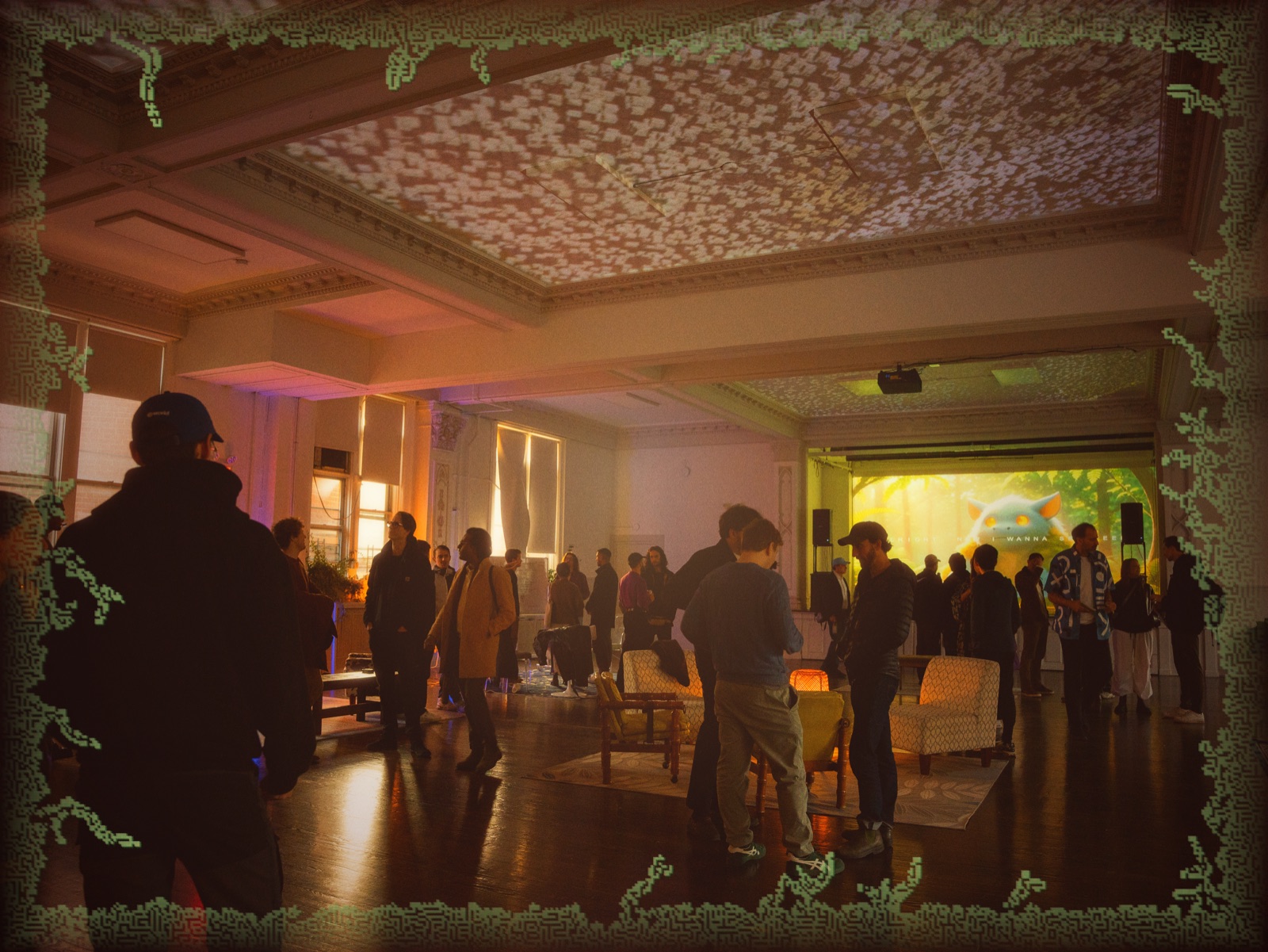
Vishesh, a resident builder who works at the seam of generative art and on-device AI, describes the format he'd like the room to grow into as “a World Expo, but every week.” It is not yet that (once a month, not every week), but in the direction of the truth, and the difference between the two has mostly to do with how many extension cords the building owns.
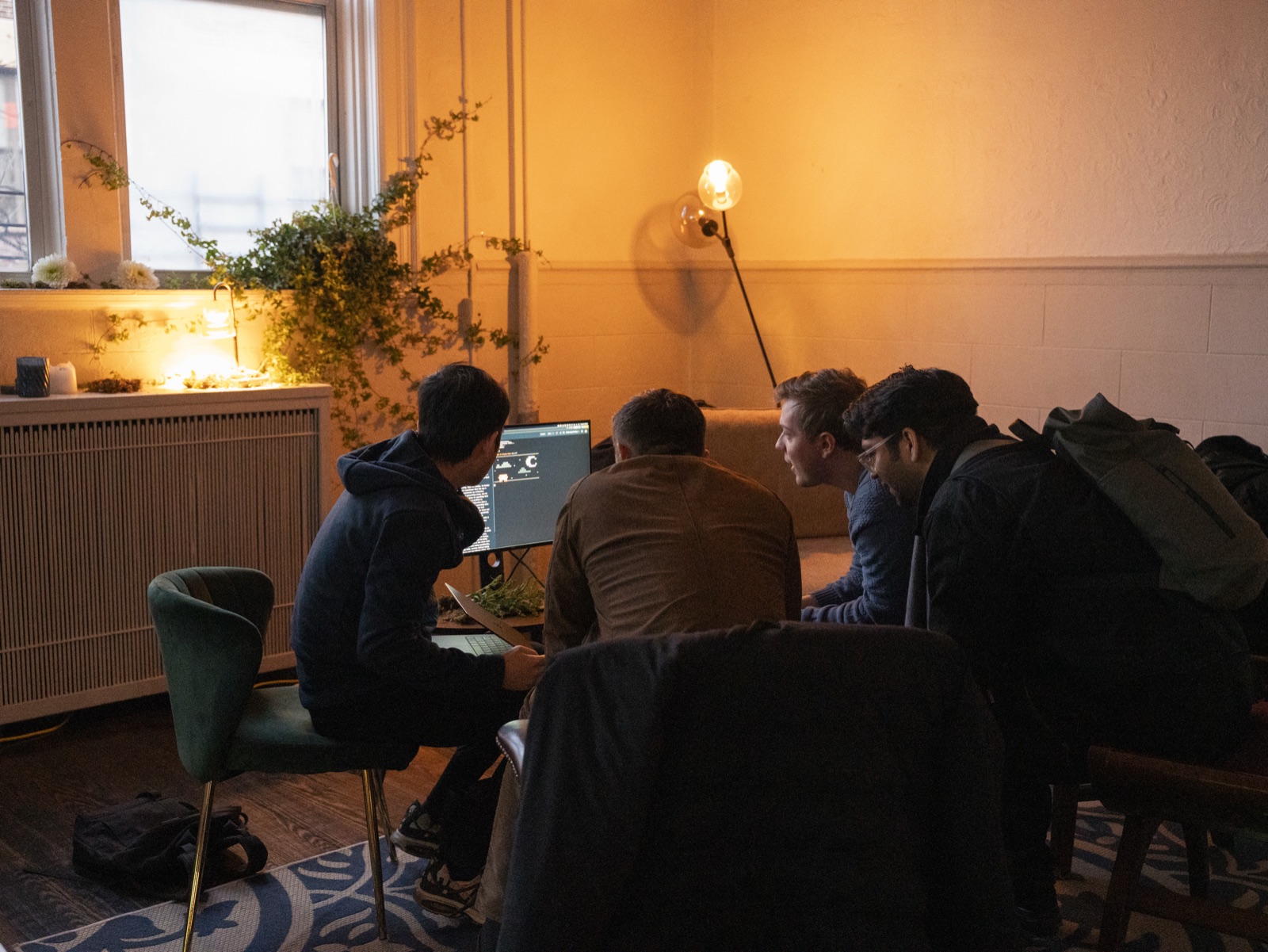
One small example of what the night is actually for: Carter Cleveland, who founded Artsy and is now building toward a more private, trust-based version of the internet (most recently a Signal-like messaging app with a local AI built for community flourishing), walked into last month's session, came back the next morning, and took a desk down the hall. He is now in conversation with Sam Gbafa, whose company TinyCloud sits in adjacent territory: sovereign identity, verifiability, the question of what it means to bring your own data to the model rather than the other way around. We are not in the business of taking credit for collisions. We are in the business of running a room where they happen.
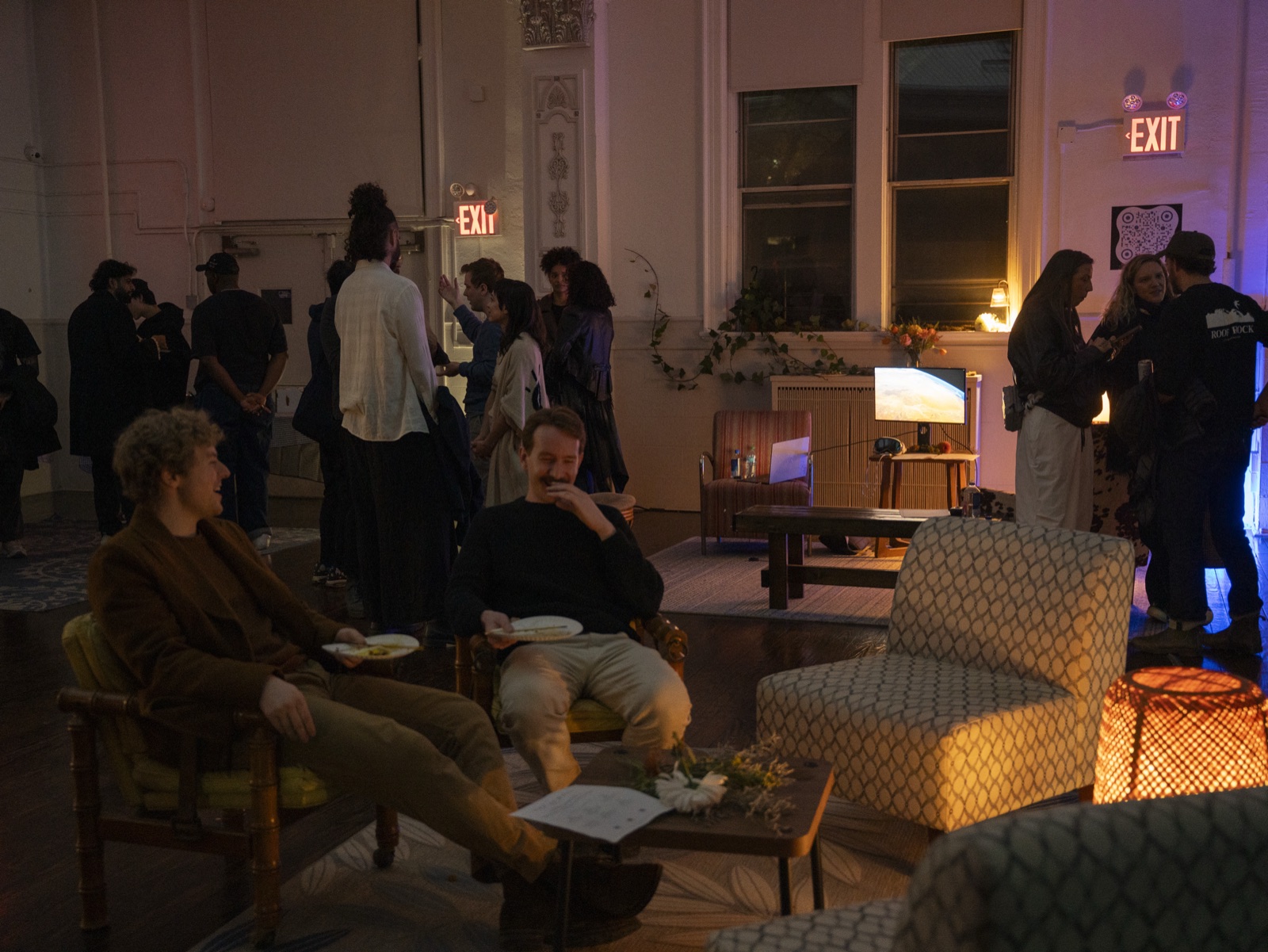
Benchmarks are not the point. The point is what happens when a model is small enough to live on a desk in Brooklyn, and what people choose to do with one once it belongs to them. If you are looking for the local AI meetup in NYC, you have found it.
ETHEREA: create as you speak.
A generative stage. The audience passes the mic; an LLM-orchestrated pipeline turns their words into a moving visual world. No two shows alike.
ETHEREA is the live storytelling system that runs out of the convent itself, on the floor with the high ceilings: a permanent generative stage where, in their own line, frontier art meets frontier models. An audience passes a microphone around a darkened room; the words they speak run through a stack of local models (among them StreamDiffusion, the open-source real-time diffusion pipeline from Daydream) into a moving visual world projected behind the speakers. The tagline is the working theory: create as you speak. The room, when it works, behaves like a story everyone is writing at the same time.
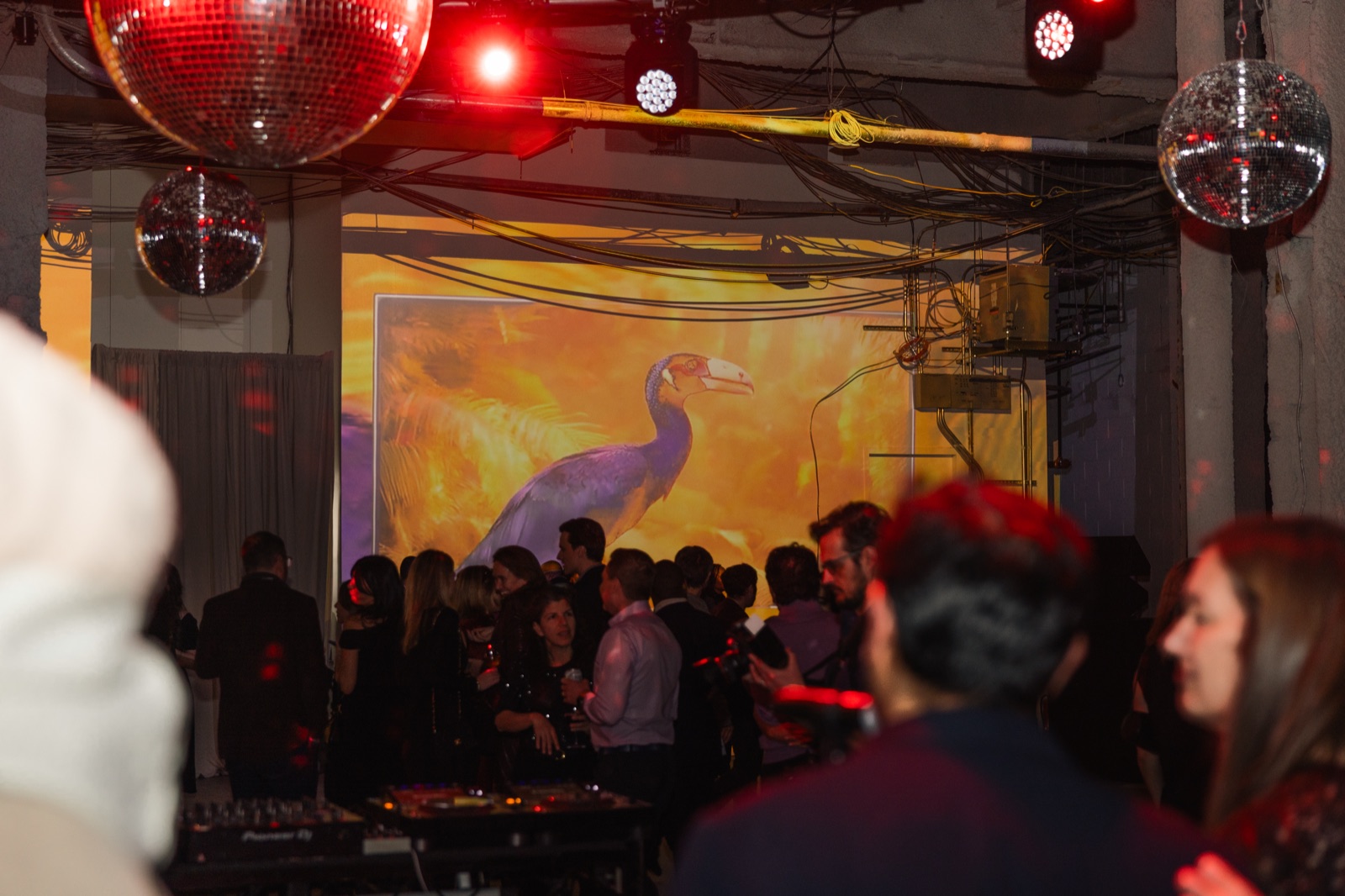
No two shows are the same, because no two audiences imagine the same thing.
— from withetherea.com
ETHEREA is built by James Barnes, who founded the project and lives in the building, and Gonzalo, his cofounder, who met him here. “We're living proof,” Gonzalo told us, “that putting the right people in the right space, building their creative confidence, can produce amazing results.” The two of them sold the project's first permanent installation last season; they have been designing successive shows for tour ever since.
It exists, in part, because the rest of the building exists. Frontier real-time diffusion work and refined visual taste tend not to live under the same roof. Dmarz, who has watched the project develop from a desk one floor up, frames the collaboration this way: ETHEREA iterates through latent space faster than most generative work because it is jointly steered by people pushing the diffusion pipeline and people with the trained sensory taste to tell the pipeline when it has done something good. Taste, in his phrasing, is a heuristic over sensory space. The system is the heuristic put into the loop.
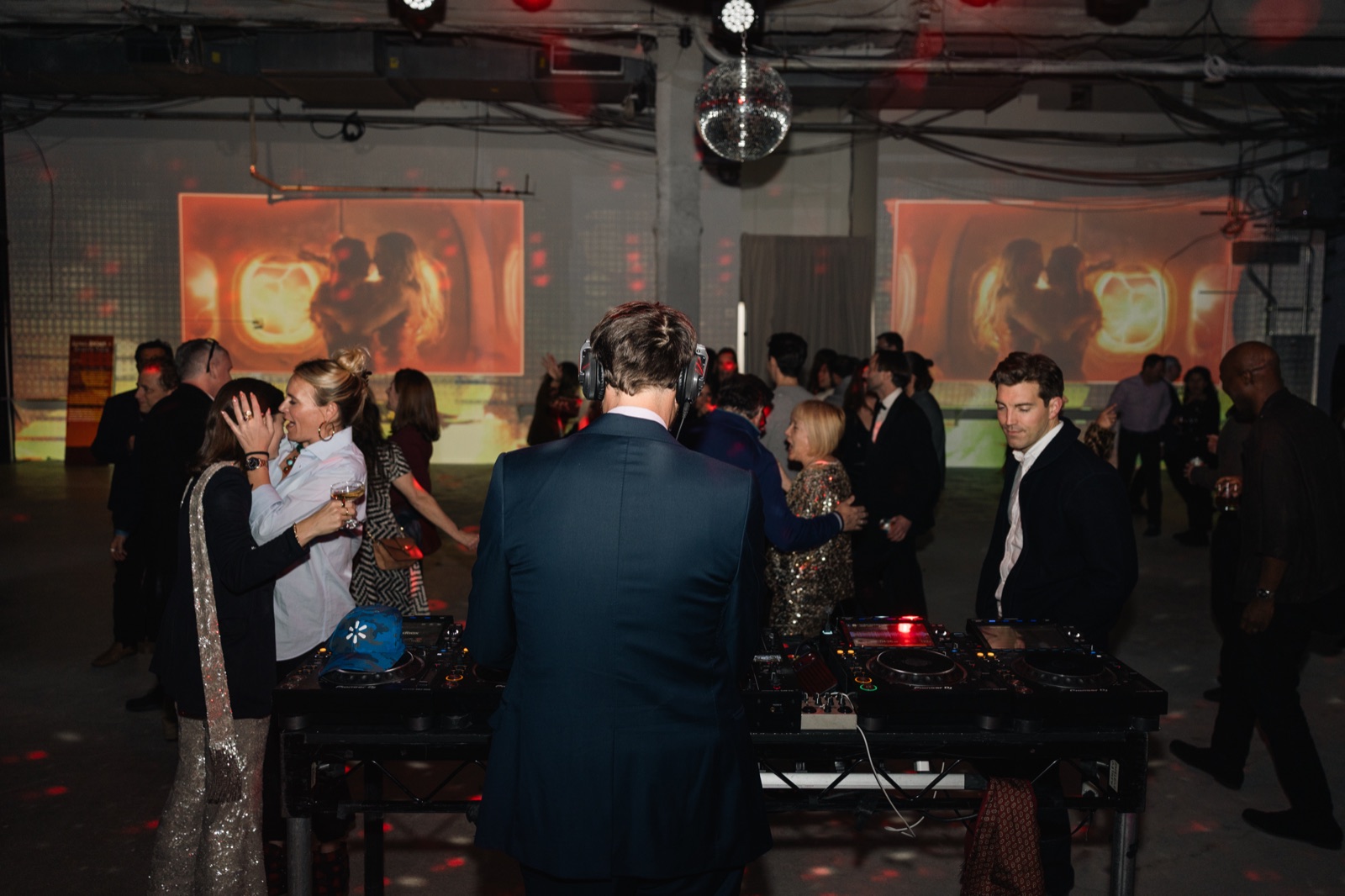
It is part performance, part participatory art. The system also tours: over nearly two years, thousands of people in different cities have passed the mic in front of it and watched their half-sentences become weather.
The lag between voice and image is the standing design question. Faster, and the system reads as a slot machine. Slower, as a séance. The seam between the two is where the work has been good, and the room tightens or loosens it depending on whether the next person in the circle has ever held a microphone before.
SoundTemple: the room as instrument.
A listening room under construction in the School basement: five transducers per bed, projection, and a small room tuned for collective attention.
SoundTemple carries the same local-art argument into the School basement. If ETHEREA turns speech into projected weather, SoundTemple is being built to turn sound into architecture: full-body vibration, projection, and a room tuned for people to listen together instead of alone. The public site calls it immersive sonic architecture, “where vibration becomes experience, and space becomes instrument.” The crucial unit is the bed: the current prototype has five transducers installed in each one, turning the platform into a resonating surface that carries the composition through the listener's body while the room supplies the shared image and sound.
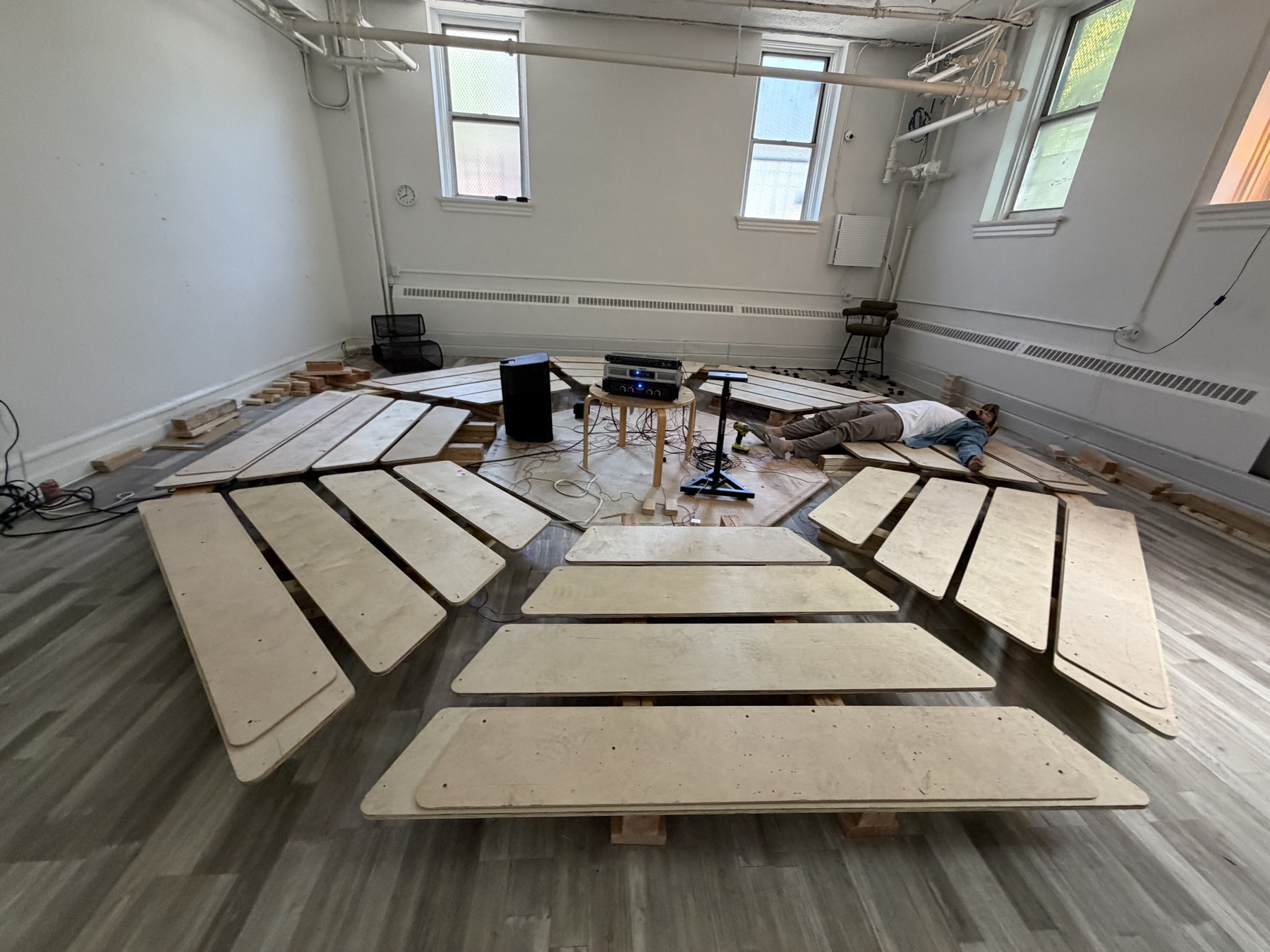
The idea has already left the building once. SoundTemple debuted publicly in 2025 at Experts Only Festival, with listeners lying on the prototype beds while ETHEREA projections moved across the room's acoustic shell. The basement build is the same premise brought home and made permanent: SoundTemple carrying the composition through the body, ETHEREA filling the ceiling, and the audience listening from inside both systems at once.
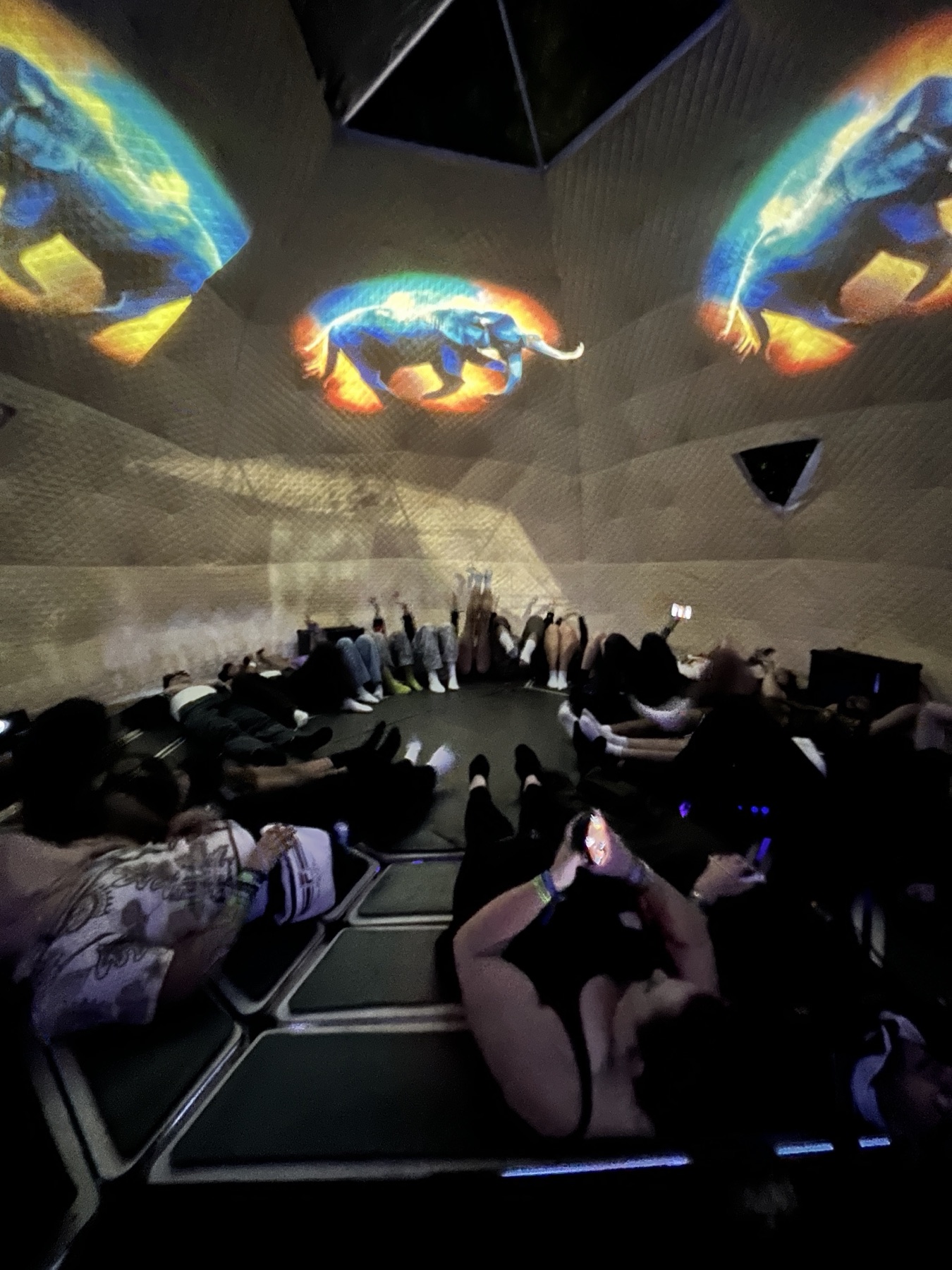
Gonzalo describes the basement build as “a listening room that can hold from 8-16 people together, all resonating on the same frequencies” and, more plainly, “a new instrument for the collective.” The phrase is useful because it refuses to make the room only a venue. A venue contains a performance; an instrument has to be played. SoundTemple is being assembled around that distinction: vibrations that paint the sensation of sound through one body, then ripple into the rest of the listeners around it.
VoxTerm: a transcript that stays in the room.
A LAN-only, peer-to-peer, on-device LLM transcription app: listens to a meeting, names the voices, and shares notes between the laptops in the room.
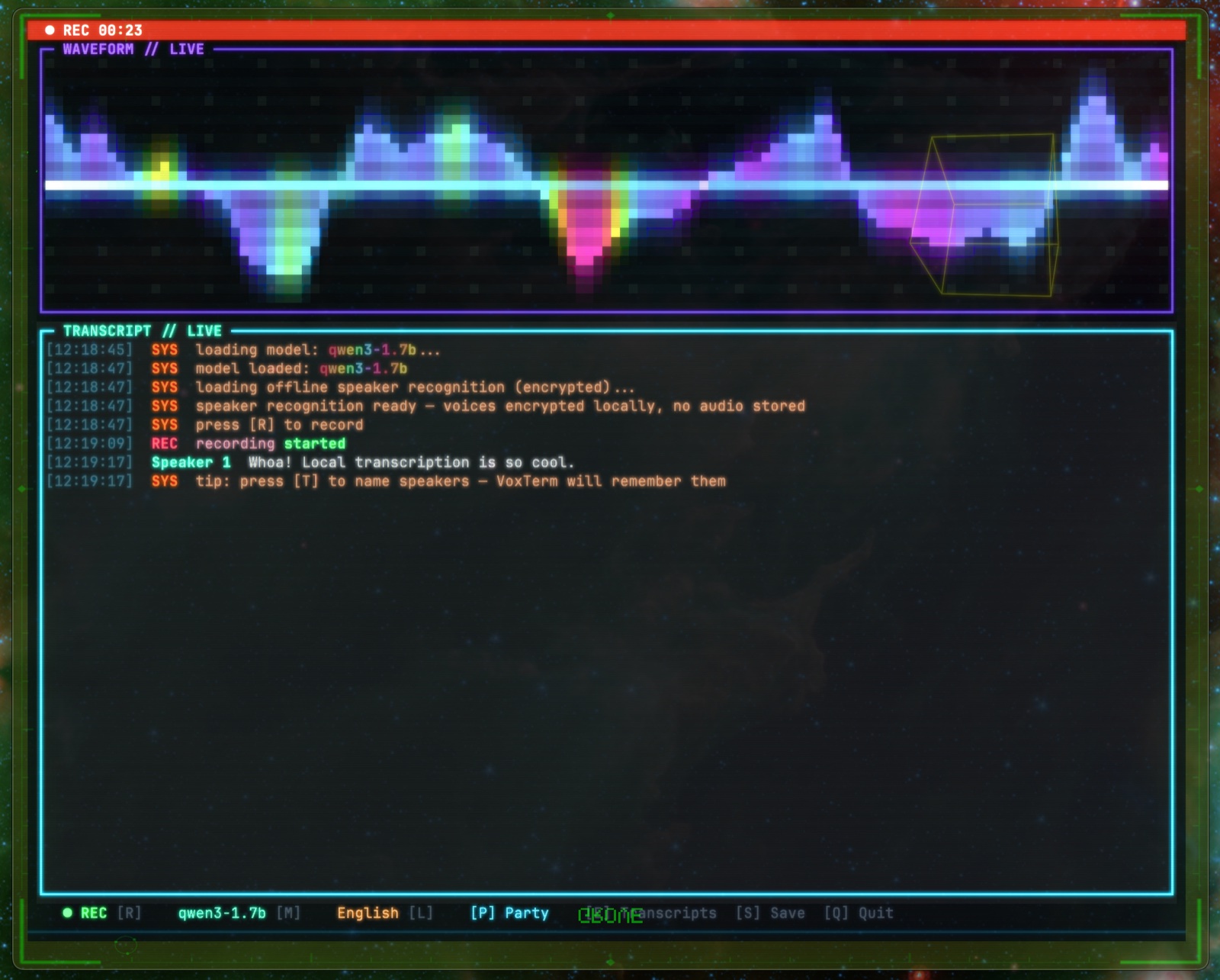
VoxTerm, written by Dmarz and Ron Turetzky, is the LAN-only, peer-to-peer, on-device LLM transcription app we wrote when we kept ending the meetup wishing we had one. A microphone catches the room; an open-weights transcriber on the laptop, your choice of Whisper (tiny through large-v3) or Qwen (0.6B and 1.7B), turns audio into text. A second small model handles diarization: CAM++, a context-aware speaker-verification network that posts 0.73% EER on VoxCeleb-O at roughly half the parameter count of ECAPA-TDNN, and learns to recognize each voice across sessions. None of it leaves the device. The audio is never written to disk, only the transcript is, in markdown, in a folder you choose.
We made it a TUI on purpose. The terminal is the most platform-agnostic surface still in good standing. It runs on any machine that runs anything, needs no renderer, and saves us from futzing with whichever heavy UI framework is fashionable this season. Dmarz puts the design orientation this way: “As software engineers we have been trained to make our software maximally portable and accessible, leading to boring websites that satisfy all screen sizes, frameworks, and operating systems. With TUIs we take the opposite path: we work in terminals daily, we don't need fancy frameworks, we need what connects us and works for us.” The form is also having a moment: lazygit, yazi, and a quiet wave of apps built on ratatui and textual have turned text-based interfaces (which date to the early 1970s) into one of the better threads on Hacker News this year.
There is a party mode. Press N on two or more laptops on the same network and they discover each other over mDNS (with no central bootnode, just UDP multicast over the network), share an encrypted color, and merge their transcripts in real time. Each laptop captures its closest speaker best, so a four-laptop party produces a transcript no single microphone could have. No relay servers; if you can ping it on the LAN, it can hear you.
VoxTerm is also one of the building's quieter cross-floor collaborations. Vishesh, whose work on programmable LEDs lives one room over, is wiring a strip of his hardware into the transcript stream so that the room can, in his phrasing, “see what it's saying.” The integration is not finished. That it is being built at all is one of the small reasons people who live here do.
VoxTerm is open source and lives at dmarzzz/VoxTerm.
Searching with Frnds.
A local-first p2p search engine.
Searching with Frnds, a fork of SearXNG, is a peer-to-peer search engine: it asks first what's on your laptop, then what's on the laptops of trusted friends on the LAN, and only after that does it reach for the public web. The premise is that most of what you search for, you've searched before, and the people you trust have probably touched the territory next door, so a search engine built for that should look nearby before it looks anywhere else. And when the query has to go out, when nothing nearby answers, the friend circle will bootstrap a DC-net on top of itself: an information-theoretic anonymity primitive from 1988 that makes the query untraceable to any single member of the group, including by the other members. It is the argument from § II, one layer up the stack: the case for software you can break, fix, and outlive, applied now to the substrate your software searches through.
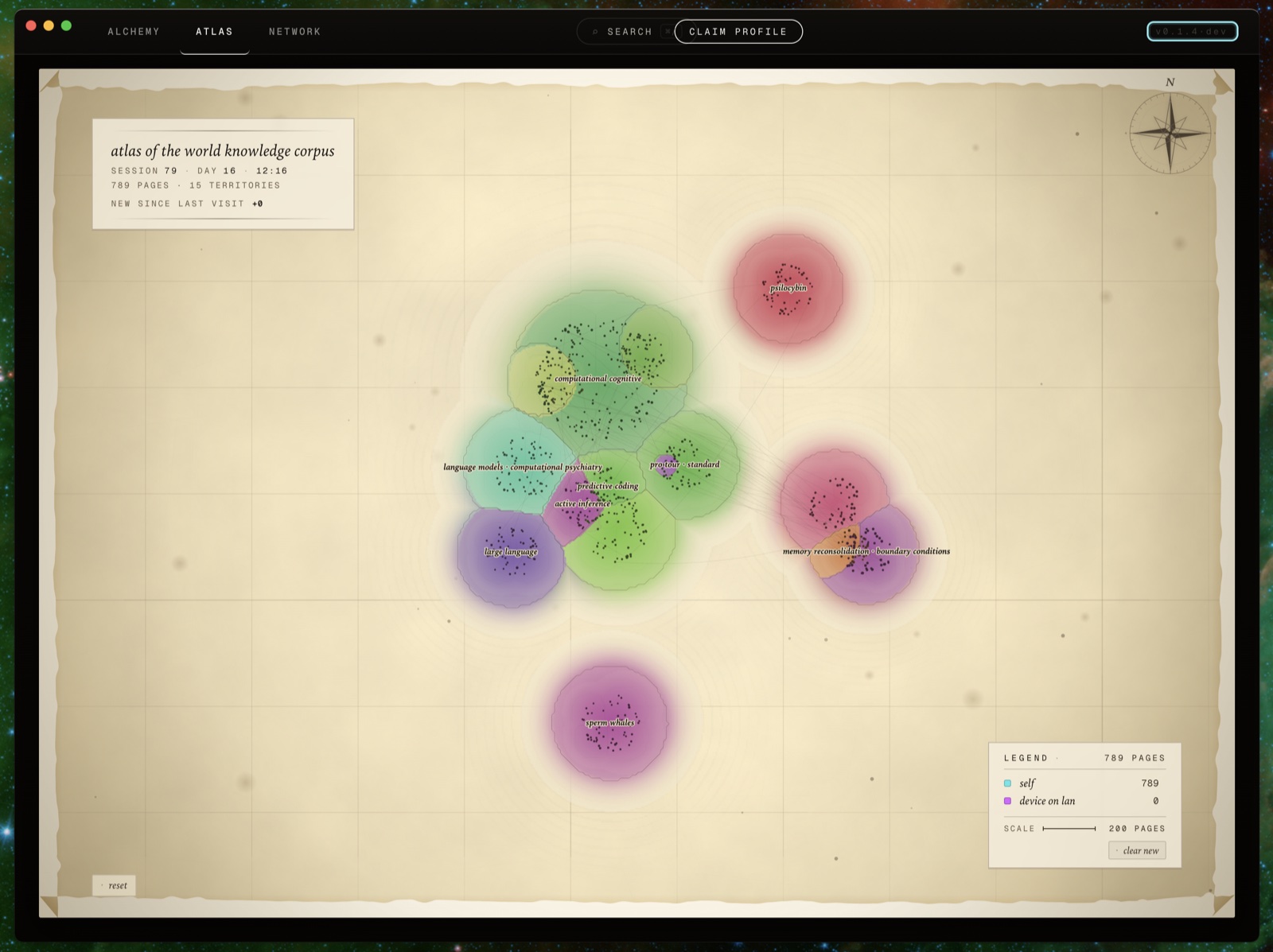
The Atlas plots that shared index as a living map: each member's clicks and queries claim a region, and the territory grows with use. At The School, it runs on a projector in the main hall, where the cohort tracks whose corner is growing fastest and which clusters are merging into something new. We are leaning into the game of it on purpose. The map evolves with the room's curiosity.
The Greenpoint Compute Co-op.
A fundraise, a room, and a model that doesn't exist yet.
In the room next to the boiler-room stairs there is, at the moment, a desk and a power drop. By the end of summer, if the math works, there will be a workstation on it. It will be the entire compute footprint of the Greenpoint Compute Co-op, a small group raising the price of an NVIDIA GB300 workstation to fine-tune open-weights models on the activity of their own cohort: calendars, decisions, the things people end up agreeing to over a Tuesday dinner. The model is meant to help that cohort coordinate. The premise, in their words: “a model that helps a specific group coordinate is the smallest honest instance of that work.”
The structure is straightforward. Contributors fund the hardware and operations, get early access to the model once it lands, and are listed by name on the workstation itself: a brass plaque on the chassis. Donations are accepted in ETH or by bank transfer. The full pitch, and the running tally, lives at wrld.nyc.
Shape Rotator, soon.
An accelerator for people building things that run on the desk in front of them.
After this issue closes we are turning toward the Shape Rotator program, an accelerator for projects that share the same disposition as the work in this issue: small, local-first, opinionated, willing to be wrong on purpose. Quintus, who came up through Flashbots' R&D group and is a frequent presence in the building, describes the orientation we're trying to select for as cautiously optimistic technological work: neither blind techno-acceleration nor reactive techno-pessimism, but a careful insistence on building things in the open and watching what they do.
The shape is closer to a graduate seminar than a startup accelerator: ten weeks, a single cohort, projects and individuals evaluated on separate tracks, with the expectation that teams will dissolve and recombine around what is working as the season unfolds. The midpoint lands during ETH New York in early June, an open demo evaluated against the whole conference's noise. The close is a smaller, more curated showcase, calibrated per team: for the for-profit projects, what investors need to see; for the open-source and coordination tools, what users need in order to adopt them. Cohorts will be a season long. The first one starts soon; details at shaperotator.xyz before we publish issue 002.
Prompter is one of the first tools we expect to put through that process. The open-source repo is only the first step; the useful version is a local documentarian that can interview, remember, and assemble stories using the building's own compute instead of a remote studio stack.
Endnotes & references
- 1. The Grove. grov3.net. Greenpoint, Brooklyn.
- 2. ETHEREA. withetherea.com. The Convent, Greenpoint.
- 3. SoundTemple. soundtemple.nyc; construction reel by Gonzalo Gelso, Instagram; prototype debut at Experts Only Festival, 2025.
- 4. VoxTerm. github.com/dmarzzz/VoxTerm.
- 5. Greenpoint Compute Co-op. wrld.nyc.
- 6. Shape Rotator. shaperotator.xyz.
- 7. Prompter. github.com/jameslbarnes/prompter.
- 8. “Why TUIs are back,” Hacker News.
- 9. lazygit, jesseduffield/lazygit; yazi, sxyazi/yazi; ratatui, ratatui.rs; textual, textual.textualize.io.
- 10. Text-based user interface, Wikipedia.
- 11. Vitalik Buterin, “Secure LLMs,” vitalik.eth.limo, April 2026.
- 12. “Anthropic Doesn't Want Your Subscription Anymore,” Kilo Blog.
- 13. Searching with Frnds. github.com/dmarzzz/searxng-wth-frnds.
- 14. David Chaum, “The Dining Cryptographers Problem: Unconditional Sender and Recipient Untraceability,” chaum.com, 1988.